

Maths - Learning Times Tables
Maths - Learning Times Tables
Why are times tables so important?
Times tables are a vital part of children’s mathematical development. Being able to recall multiplication and division facts quickly and confidently helps children to tackle more complex maths with greater ease. They are the building blocks of maths, and with times tables mastered, your child can do anything!
At Colmers Farm Primary School, we encourage children to practise little and often, building their knowledge gradually as they move through school. Our aim is for children to develop fluency, confidence and understanding, rather than simply memorising facts.
In KS2, Mastering Number lessons support pupils’ developing number sense. The inclusive, regular sessions support pupils to a develop deep, secure understanding and automatic recall of multiplication and division facts, giving them the number sense needed for future mathematical success.

Pupils in Years 2 – 6, have access to Times Tables Rock Stars (TTRS). TTRS is an award-winning online maths programme that helps pupils improve their multiplication and division fluency through engaging, game-based activities. Effort and engagement are rewarded in our weekly celebration assemblies and progress is shared with parents through fact fluency heatmaps.

In addition to Mastering Number and TTRS, pupils have their own log-in to Magma Maths. Magma is an online maths platform that is accessed in school and at home to further consolidate maths understanding. Magma promotes deeper mathematical thinking, enabling pupils to apply their times table knowledge to more challenging contexts.
Helping your child at home
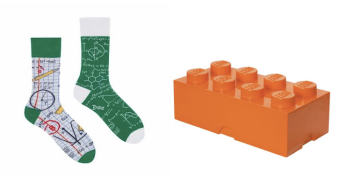
Visuals really support pupils in understanding the concept of multiplication and division. Counting in 2s can begin with using simple manipulatives such as shoes, socks and gloves. Using household objects makes learning more fun. Another example might be to count in 5s using 5p coins, or counting ‘high fives’ between family members.
Counting out loud in steps will help familiarise your child with multiples for each times table (e.g. the multiples of 5 are 5, 10, 15, 20 etc.) Whenever children start learning a new times table, they should be given the opportunity to see what it looks like. Lego bricks with eight dots on the surface are a great way to reinforce multiples of 8.
Make it fun! Use:
- Times table songs
- Flashcards
- Board games
- Online games and quizzes
- Dice
- Cards
- Quick-fire questions
Use everyday opportunities. Times tables are everywhere! Ask questions when:
- Shopping - "We need 4 apples each for 3 people. How many apples do we need?"
- Cooking
- Sharing food
- Counting objects
- Telling the time
- Calculating prices
- Planning journeys
Times table expectations by year group
Below is a summary of the National Curriculum expectations and some more ideas for home learning.
Year 1
Pupils begin to develop an understanding of multiplication through practical activities, grouping and counting. Pupils practice counting forwards and backwards in multiples of 2, 5, and 10.
At home: practise counting in 2s, 5s and 10s through songs, games and everyday activities.
Year 2
Children build on their Year 1 knowledge and develop greater fluency.
Multiplication and division facts:
- 2 times table
- 5 times table
- 10 times table
- Counting in steps of 3
Pupils should increasingly be able to recall these facts accurately and use them to solve simple problems. Pupils begin to recognise and use related division facts, for example:
2 × 5 = 10
10 ÷ 2 = 5
At home: ask questions in different ways, such as:
"How many 3s are in 18?"
"What is 5 × 4?"
"If I have 20 sweets and share them between 5 people, how many does each person get?"
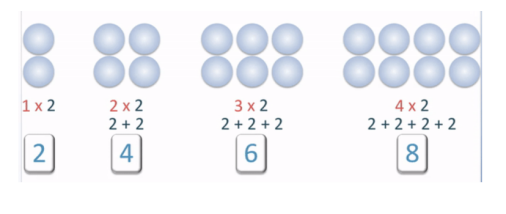
In KS1, pupils learn how to use the ‘x’ symbol by understanding that multiplication is repeated addition. Visuals, such as ‘arrays’, support with this:
 Year 3
Pupils expand their knowledge of multiplication and division facts.
New times tables:
- 3
- 4
- 8
Children should develop increasing speed and accuracy when recalling facts and begin to use them confidently when solving problems.
At home: encourage children to notice patterns between tables. For example, knowing the 4 times table can help with the 8 times table.
Year 4
Year 4 is an important year for developing rapid recall and fluency. By the end of Year 4, pupils work towards recalling all multiplication and related division facts to 12 x 12 quickly and accurately.
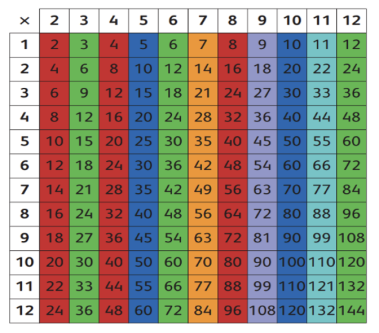 At school, pupils take the Multiplication Times Tables Check (MTC). This is a short, online assessment designed to check children’s fluency with multiplication facts.
At home: regular short practice is particularly valuable. Aim for a few minutes at a time rather than long sessions.
Year 5
Pupils continue to secure all multiplication and division facts up to 12 × 12. The focus moves beyond simply recalling facts to applying them to more challenging mathematics, including:
- Larger numbers
- Fractions
- Decimals
- Percentages
- Written multiplication and division
- Problem solving
At home: continue to practise any facts that are not yet automatic and encourage children to explain how they know an answer.
Year 6
By Year 6, pupils should have secure and fluent recall of all times tables up to 12 × 12. They should be able to use their knowledge confidently when working with:
- Fractions
- Decimals
- Percentages
- Ratio and proportion
- Long multiplication
- Long division
- Multi-step problems
Remember…
Every child learns at their own pace. The most important thing is to build confidence and develop secure understanding. Celebrate progress; praise effort and improvement, not just speed. Don't worry about mistakes; mistakes are an important part of learning. Use the information above to build on what your child already knows; secure one set of facts before moving on to another.

If you require any further support for your child, please contact the school or speak to your child's class teacher.